A non-disclosure agreement template gives you a fast, reliable way to protect business ideas, client lists, pricing, source code and other sensitive information before you share it. Whether you are pitching an investor, hiring a contractor or exploring a partnership with another company, a signed NDA sets clear rules about what can be shared, who can see it and for how long it must stay private.
Below you can download two free, fully editable NDA templates in Word and PDF: a one-page mutual NDA for quick everyday use, and a detailed one-way NDA with schedules and checkboxes for higher-stakes disclosures. After the downloads, we explain every key clause and how to fill the form in correctly.
What Is a Non-Disclosure Agreement?
A non-disclosure agreement (also called a confidentiality agreement or NDA) is a legally binding contract in which one or both parties promise not to disclose or misuse confidential information they receive from the other. The party sharing information is the disclosing party, and the party receiving it is the receiving party.
There are two main types:
- One-way (unilateral) NDA: only one side shares confidential information. This is common when a business hires a freelancer, shows a product to a manufacturer or onboards a new employee.
- Mutual (bilateral) NDA: both sides share sensitive information and both agree to protect it. This suits joint ventures, merger talks and technology partnerships.
An NDA does not stop anyone from doing business; it simply controls how protected information is used. It is often signed before a larger agreement, such as a contract between two companies or a consulting engagement, is negotiated.
Download Free NDA Templates (Word & PDF)
Pick the format that suits your situation. Both templates are free, fully editable in Microsoft Word or Google Docs, and include [BRACKETED] fields so you can complete them in minutes.
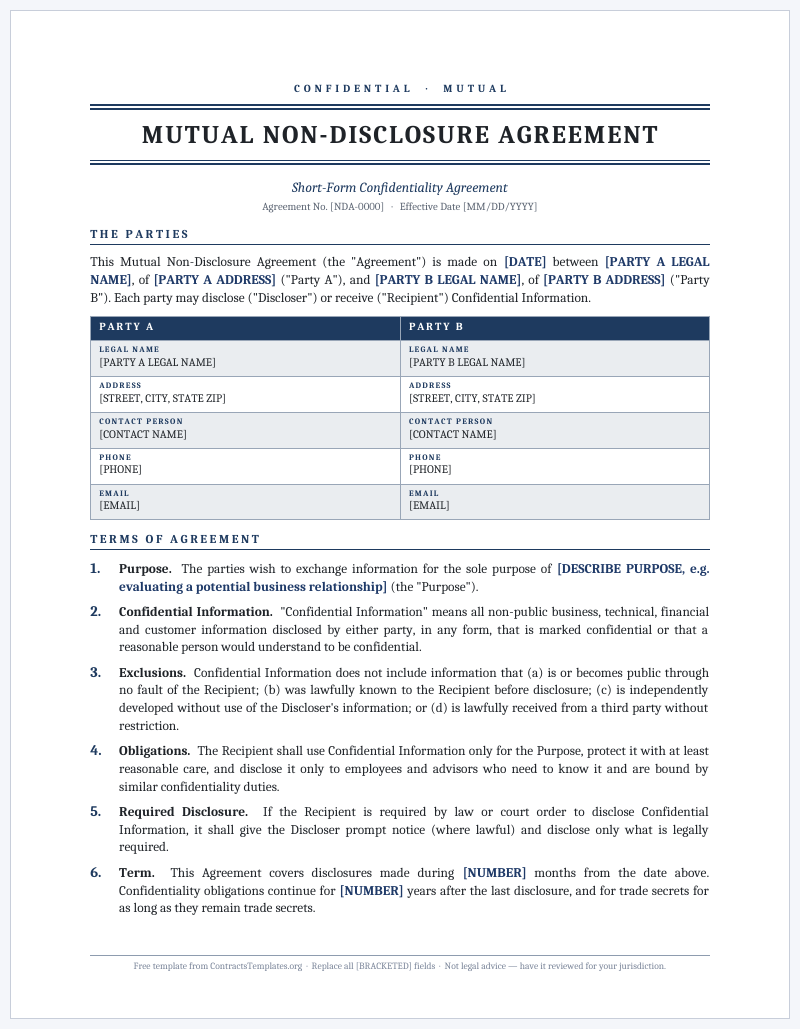
Template 1: One-Page Mutual NDA (Short Form)
A clean, single-page mutual confidentiality agreement with ten numbered clauses. Ideal for initial business meetings, partnership talks and quick deals where both sides share information.
- Mutual obligations for both parties
- Standard exclusions, term and return-of-information clauses
- Simple signature block for two parties
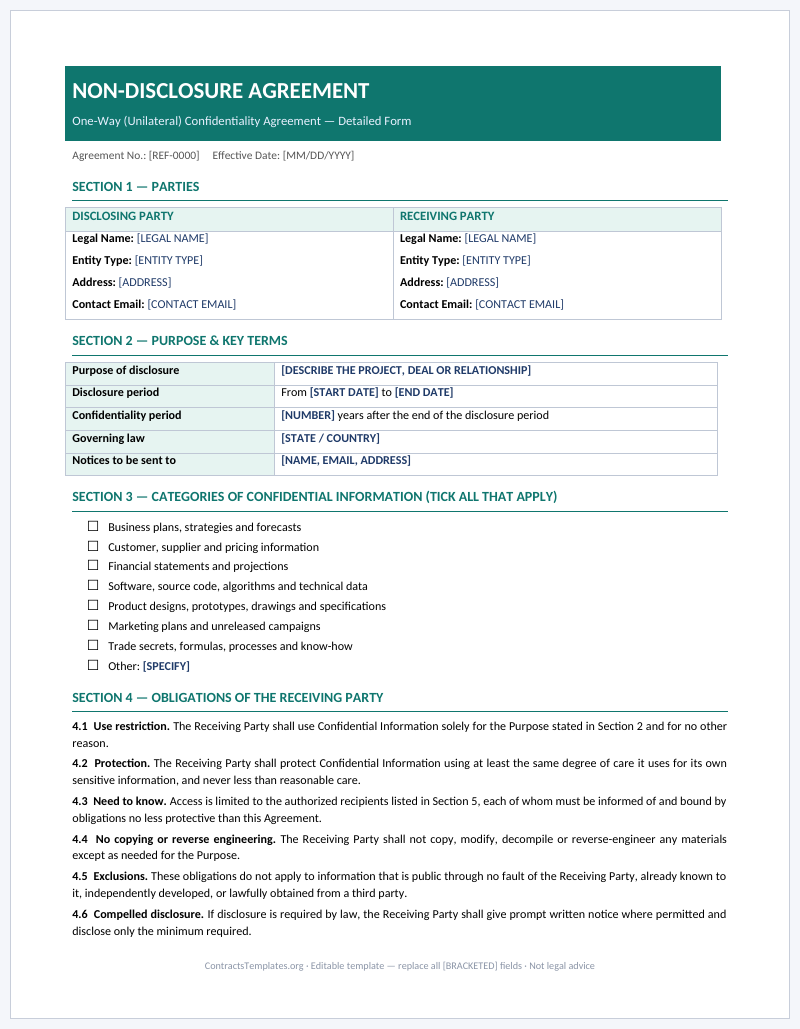
Template 2: Detailed One-Way NDA (Form Style)
A comprehensive unilateral NDA laid out as a form, with party tables, checkboxes for categories of confidential information, a permitted-recipients schedule and a signature table. Best for contractors, investors and product disclosures.
- Checkbox list of information categories
- Schedule of disclosed materials and authorized recipients
- Remedies, return of materials and governing-law sections
When Do You Need an NDA?
You should consider a confidentiality agreement any time you are about to reveal information that gives you a competitive edge and that you would not want a competitor, the press or the public to see. Typical situations include:
- Pitching a business idea, invention or product design to investors, manufacturers or potential partners.
- Hiring employees, interns, freelancers or consultants who will access internal systems, customer data or trade secrets.
- Sharing financial records during due diligence for a sale, merger or investment.
- Working with agencies, developers or designers on unreleased products or campaigns.
- Licensing software, recipes, formulas or processes to another business.
If you are bringing in an outside advisor, pair the NDA with a consulting contract template so that confidentiality and the scope of work are both covered.
Key Clauses in a Non-Disclosure Agreement
A good NDA is short enough to be signed quickly but precise enough to hold up if there is a dispute. These are the clauses that matter most.
Definition of Confidential Information
This is the heart of the agreement. Describe the categories of information covered, for example business plans, customer lists, pricing, software, designs, financial data and know-how. Avoid defining it so broadly that it covers everything, because courts may view an unlimited definition as unreasonable. Many NDAs also cover information disclosed orally if it is identified as confidential at the time or confirmed in writing afterwards.
Exclusions
Standard exclusions state that information is not confidential if it is already public, was already known to the receiving party, is independently developed without using the disclosed information, or is lawfully received from a third party. Including these exclusions makes the agreement fairer and easier to enforce.
Obligations of the Receiving Party
Spell out what the recipient must do: use the information only for the stated purpose, limit access to people who need to know, apply reasonable security measures, and not copy or reverse-engineer materials without permission.
Term and Duration of Confidentiality
Separate the length of the agreement (the period during which information is exchanged) from the length of the confidentiality obligation. Two to five years is common for general business information, while trade secrets are often protected for as long as they remain secret.
Return or Destruction of Information
When the relationship ends or on request, the recipient should return or securely destroy all confidential materials and confirm in writing that this has been done.
Remedies, Governing Law and Signatures
Most NDAs state that a breach may cause irreparable harm, allowing the disclosing party to seek an injunction in addition to damages. Name the state or country whose law applies, and make sure an authorized person signs for each party.
How to Fill In the NDA Template
Both downloadable templates use [BRACKETED] placeholders so you can see exactly what to change. Follow these steps:
- Choose the right version. Use the one-page mutual NDA when both parties share information; use the detailed one-way NDA when only you are disclosing or when the information is especially valuable.
- Enter the parties. Add full legal names, business type (for example, an LLC or corporation) and addresses. Use the registered company name rather than a trading name.
- State the purpose. Describe in one sentence why information is being shared, such as “evaluating a potential software development project.”
- Define the confidential information. Tick or list the categories that apply and add any specific documents or prototypes.
- Set the term. Enter the agreement period and how long confidentiality lasts after it ends.
- Select governing law. Insert the state or country whose laws will apply.
- Review, sign and date. Remove any instructions, save a PDF copy, and have each party sign. Keep a signed copy for your records.
Tips and Common Mistakes to Avoid
- Signing too late. Get the NDA signed before you share anything sensitive. Information disclosed before signing may not be protected.
- Vague purpose clauses. If the purpose is unclear, it is harder to prove the recipient misused the information.
- Forgetting employees and advisors. Require the receiving party to bind its staff and advisors to the same confidentiality terms.
- Unreasonable terms. Extremely long durations or one-sided penalties can make an NDA harder to enforce and may scare off good partners.
- Mixing NDAs with non-competes. A non-disclosure agreement protects information; restricting someone from working for competitors is a separate issue with its own legal limits.
- Not marking documents. Label sensitive files “Confidential” so there is no argument later about what was covered.
For broader commercial arrangements, you can also browse our business contract template and other agreements in the Non-Disclosure Agreements category.
Frequently Asked Questions
Is a free NDA template legally binding?
Yes, an NDA created from a template can be legally binding if it is properly completed, describes the confidential information clearly, is supported by consideration (such as access to the information or a business opportunity) and is signed by both parties. Enforceability depends on local law, so have important agreements reviewed by a lawyer.
What is the difference between a mutual and a one-way NDA?
In a one-way NDA only one party discloses information and only the recipient takes on confidentiality obligations. In a mutual NDA both parties share information and both promise to protect it.
How long should an NDA last?
Many business NDAs protect information for two to five years after disclosure. Trade secrets may be protected indefinitely for as long as they stay confidential. Choose a period that matches how long the information will realistically stay valuable.
Does an NDA need to be notarized?
Generally no. Most NDAs only need the signatures of authorized representatives of each party. Notarization is rarely required, although some parties choose it for added proof of signing.
Can I use an NDA with employees?
Yes. Employers commonly use NDAs or confidentiality clauses for staff who handle sensitive data. Be aware that some jurisdictions restrict NDAs that would prevent employees from reporting illegal conduct or discussing workplace harassment, so check local rules.
What happens if someone breaks an NDA?
The disclosing party may seek a court order (injunction) to stop further disclosure and may claim damages for losses caused by the breach. The exact remedies available depend on the agreement and the governing law.
Legal Disclaimer
The templates and information on this page are provided for general informational purposes only and are not legal advice. Laws on confidentiality and trade secrets differ between countries and states. Consult a qualified attorney before relying on any agreement for an important transaction.