A commission agreement template sets out exactly how a salesperson, agent or referral partner earns money for the sales they bring in. It defines the commission rate, what counts as a qualifying sale, when commission is earned and paid, and what happens if a customer cancels or the relationship ends. Clear terms keep motivation high and prevent the most common source of sales disputes: disagreements about money owed.
Below you can download two free, editable commission agreements in Word and PDF. Template 1 is a one-page sales commission agreement for simple arrangements. Template 2 is a detailed form-style agreement with tiered commission rates, a territory and product table, a payout schedule, clawback rules and post-termination terms.
What Is a Commission Agreement?
A commission agreement is a contract between a business (the principal or company) and a person or firm (the sales representative, agent or referrer) who is paid wholly or partly based on the sales or deals they generate. Commission is usually a percentage of revenue or profit, a fixed amount per sale, or a mix of both.
Commission agreements are used with employees and independent contractors alike. For employees, the commission plan usually sits alongside the employment contract. For independent sales agents, it may be a standalone agreement or part of a broader business contract. It also complements the sales contract the business signs with its customers.
Download Free Commission Agreement Templates (Word & PDF)
Use the one-page agreement for a simple flat-rate commission or the detailed version for tiered plans, territories and draws. Both are free and editable in Word and Google Docs.
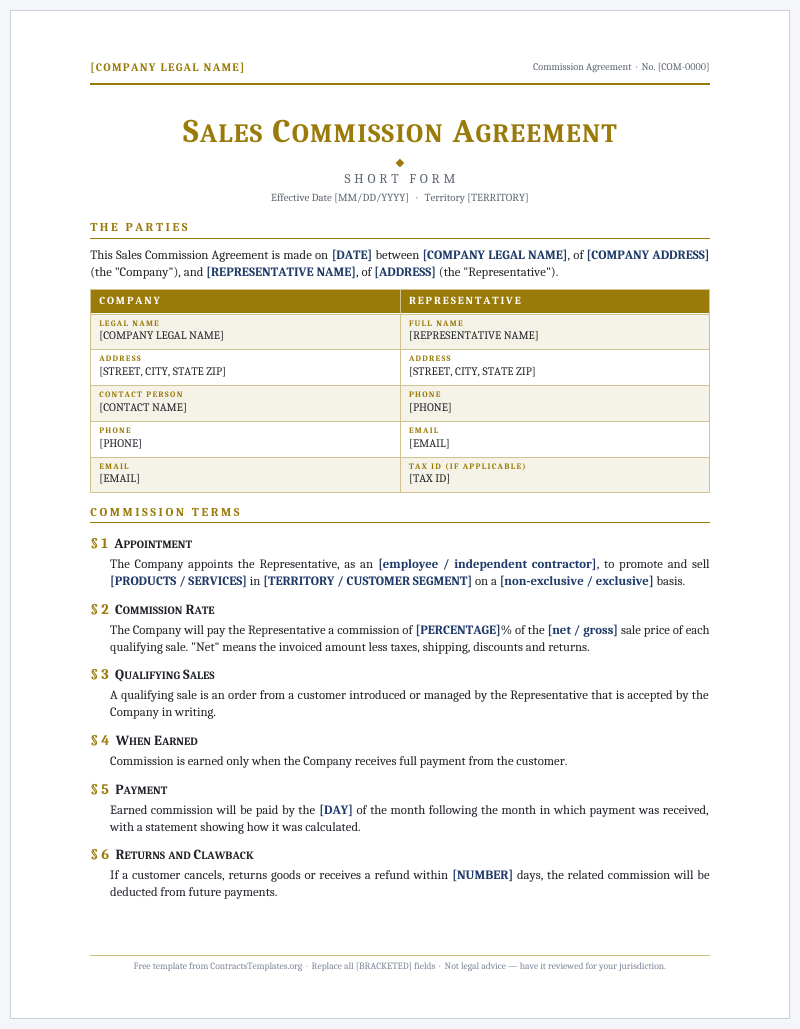
Template 1: One-Page Sales Commission Agreement
A simple, clause-based agreement covering products, commission rate, earning trigger, payment, returns, expenses and termination. Ideal for flat-rate sales reps and referral partners.
- Flat-rate commission wording
- Earned-on-payment trigger and clawback
- Representative and company signature block
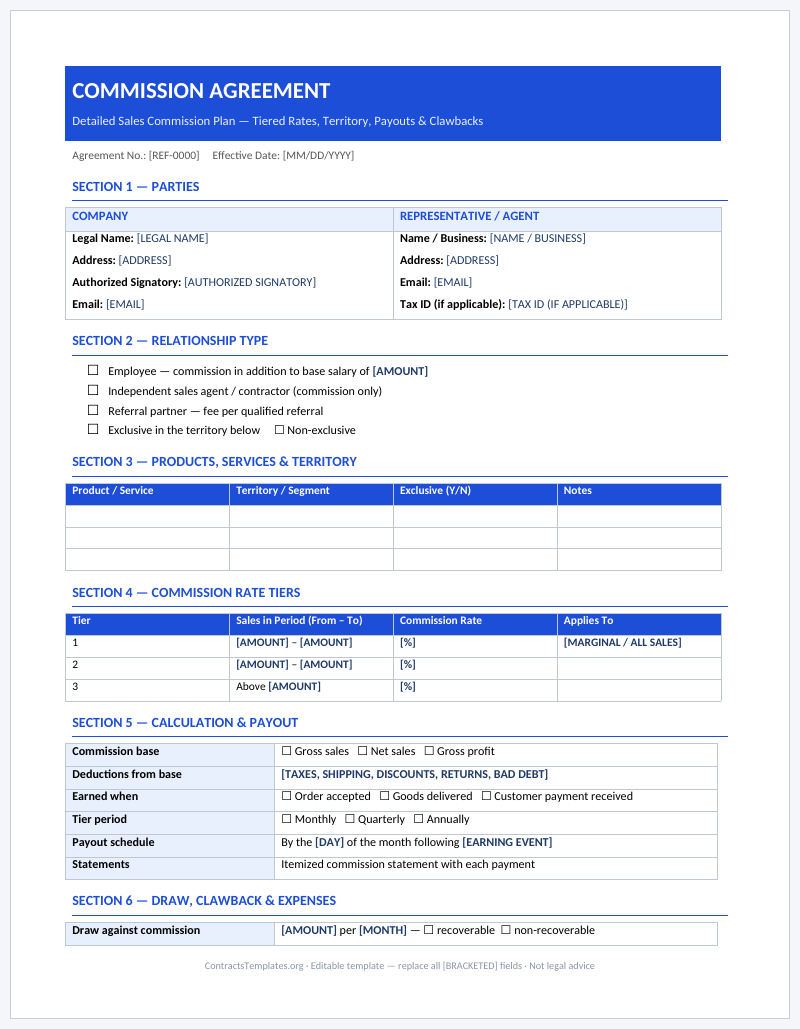
Template 2: Detailed Commission Agreement with Tiered Rates
A form-style agreement with relationship checkboxes, a products and territory table, tiered commission rate table, payout schedule, draw and clawback sections, and post-termination terms.
- Tiered commission rate table
- Products, territory and exclusivity section
- Payout schedule, draw and clawback terms
When Do You Need a Commission Agreement?
Put commission terms in writing whenever someone is paid based on results, for example:
- Hiring sales representatives paid by salary plus commission or commission only.
- Appointing independent sales agents or distributors in a new territory.
- Paying a referral fee or finder’s fee to someone who introduces a client.
- Running an affiliate or partner program for a product or service.
- Paying commission to real estate, recruitment, insurance or event-booking agents.
- Rewarding employees with a bonus tied to sales targets.
If two businesses are sharing profits on an ongoing basis rather than paying for referrals, a partnership contract may be a better fit.
Key Clauses in a Commission Agreement
Parties and Relationship
Identify the company and the representative, and state whether the representative is an employee or an independent contractor. This affects tax, benefits and how much control the company may exercise.
Products, Services and Territory
Specify which products or services the representative may sell, any geographic territory or customer segment, and whether the arrangement is exclusive.
Commission Rate and Structure
State the rate clearly. Common structures include a flat percentage of sales, tiered percentages that rise as targets are met, a fixed amount per unit, or a percentage of gross profit. Explain whether commission is calculated on gross or net amounts and what is deducted, such as taxes, shipping, discounts or returns.
When Commission Is Earned
This is the most disputed point. Is commission earned when the order is signed, when the product ships, or when the customer pays? Many businesses choose “when payment is received” to avoid paying commission on unpaid invoices.
Payment Schedule and Statements
Set out how often commission is paid (for example monthly, by the 15th of the following month) and require the company to provide a commission statement showing how each payment was calculated.
Returns, Cancellations and Clawbacks
Explain what happens if a customer cancels, returns the product or does not pay. A clawback clause allows the company to deduct previously paid commission from future payments in those cases.
Draws and Advances
Some plans pay a regular advance (a “draw”) against future commission. State whether the draw is recoverable from future commission and what happens to an unrecovered balance when the agreement ends.
Expenses
State whether the representative pays their own travel, phone and marketing costs or whether certain expenses are reimbursed.
Termination and Post-Termination Commission
Explain the notice period and how commission on deals in progress is handled after termination, for example commission on orders placed before termination and paid within a set number of days afterward.
How to Fill In the Commission Agreement Template
- Enter the parties. Add the company’s legal name and the representative’s name and address.
- Select the relationship type. Tick employee, independent contractor or referral partner.
- Define products and territory. List products or services and the geographic area or customer types covered.
- Enter the commission rates. Fill in the flat rate or complete the tier table with thresholds and percentages.
- Set the earning trigger. Choose whether commission is earned on order, delivery or payment.
- Complete the payout schedule. Enter the payment frequency and the date statements are issued.
- Add clawback and draw terms. Enter how long after a sale a clawback can apply and any draw amount.
- Set termination terms. Enter the notice period and the post-termination commission window.
- Sign. Both parties sign, and each keeps a copy.
Example: How a Tiered Commission Works
Tiered structures reward strong performance, but they need to be written precisely. Suppose a plan pays a lower rate on sales up to a first threshold each month and a higher rate on sales above it. The contract must answer two questions:
- Marginal or retroactive? In a marginal plan, the higher rate applies only to sales above the threshold. In a retroactive plan, reaching the threshold raises the rate on all sales for the period. Marginal plans are more common and easier to budget for.
- What period resets the tiers? Tiers may reset monthly, quarterly or annually. A longer period smooths out seasonal swings; a shorter one gives faster feedback.
Write a short worked example into the agreement using illustrative numbers. Seeing the calculation on paper is the quickest way to confirm that both parties understand the plan the same way.
Tips and Common Mistakes
- Ambiguous earning trigger. Always state exactly when commission is earned and payable.
- Gross vs. net confusion. Define the base used to calculate commission and list deductions.
- No clawback clause. Without one, it is hard to recover commission on cancelled or unpaid sales.
- Changing rates informally. Record any change to the plan in writing and signed by both parties.
- Ignoring local law. Some places require written commission agreements or set deadlines for paying commission after employment ends.
- Forgetting split deals. Explain how commission is shared when more than one person works on a sale.
Explore more agreements for growing companies in the Business Contracts category.
Frequently Asked Questions
What is a typical commission rate?
Commission rates vary widely by industry, product price and whether a base salary is paid. There is no universal standard, so research your industry and choose a rate that balances motivation with your margins.
When should commission be paid?
Many businesses pay commission monthly, after the customer has paid. Whatever you choose, state the payment date and the earning trigger in the agreement, and check any local legal deadlines.
What is a commission clawback?
A clawback lets the company recover commission already paid if the sale is later cancelled, refunded or not paid by the customer. It should state how long after the sale it can apply.
Can a commission agreement be used for referral fees?
Yes. Select the referral partner option, describe what counts as a qualified referral and enter the fee as a percentage of the first sale, a fixed amount or a share of revenue for a set period.
Is commission owed after the salesperson leaves?
It depends on the agreement and local law. Many agreements pay commission on orders accepted before termination when the customer pays within a defined period. Spell this out to avoid disputes.
What is the difference between a draw and a salary?
A salary is a fixed payment that does not depend on sales. A draw is an advance against future commission; depending on the agreement, unearned draws may be recoverable from later commission.
Legal Disclaimer
This commission agreement template is provided for general information only and is not legal advice. Wage, commission and agency laws vary by country and state. Have your agreement reviewed by a qualified lawyer before use.