An equipment rental agreement template protects you whenever you rent out tools, machinery, audio-visual gear, cameras, party supplies or any other valuable equipment. It records exactly what was rented, its condition, how long the renter can keep it, what it costs and who pays if something is lost or damaged.
Below you can download two free, editable equipment rental agreements in Word and PDF. Template 1 is a simple one-page agreement for quick, low-value rentals. Template 2 is a detailed, form-style agreement with an equipment schedule, a condition checklist at pick-up and return, a fee table and delivery details for larger or longer rentals.
What Is an Equipment Rental Agreement?
An equipment rental agreement (sometimes called an equipment lease agreement) is a contract in which the owner of equipment (the lessor or owner) allows another person or business (the renter or lessee) to use that equipment for a set period in exchange for payment. Ownership never transfers; the renter simply gets the right to use the equipment and must return it in the agreed condition.
Equipment rentals are usually shorter and more flexible than property leases, but the principles are similar to a lease contract: clearly identify what is being rented, the term, the price and each party’s responsibilities.
Download Free Equipment Rental Agreement Templates
Download the version that fits your rental. Both are free, editable in Word and Google Docs, and ready to save as PDF.
Template 1: One-Page Equipment Rental Agreement
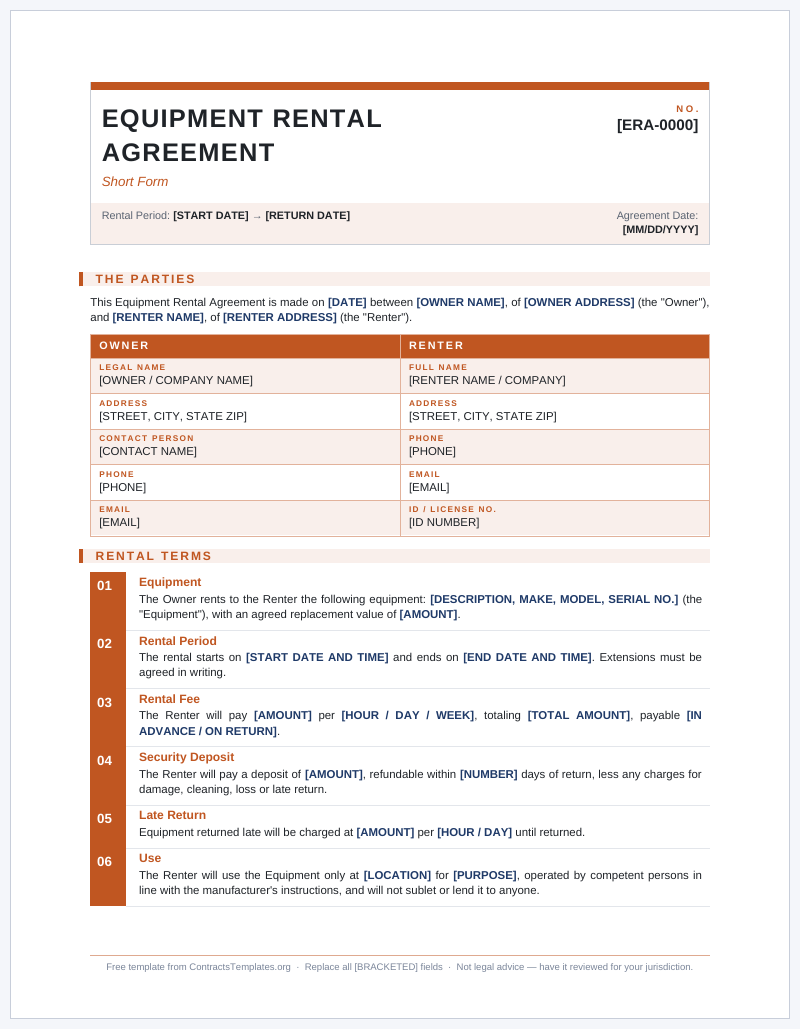
A short, numbered-clause agreement covering equipment, rental period, fees, deposit, use, damage and return. Ideal for single items or short rentals between individuals or small businesses.
- Single-page layout
- Deposit, late-fee and damage clauses
- Owner and renter signature block
Template 2: Detailed Equipment Rental Agreement with Item Schedule
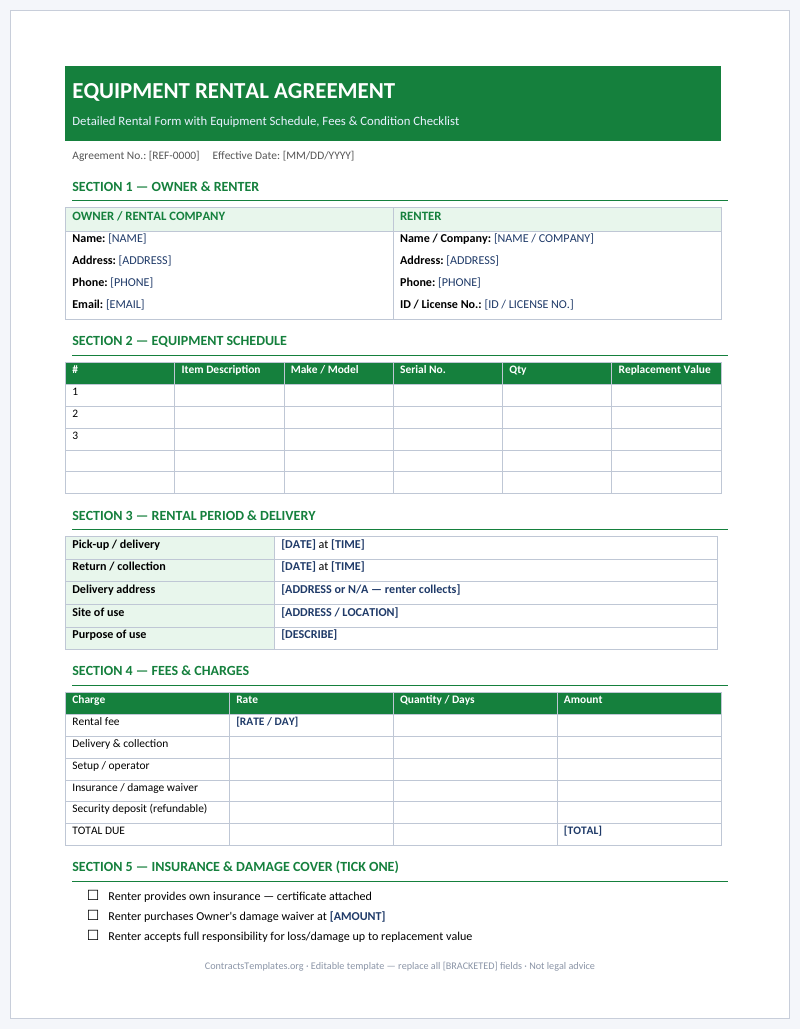
A multi-section rental form with an equipment schedule table, fee table, delivery details, pick-up and return condition checklist, insurance checkboxes and signature table. Best for multiple items or high-value rentals.
- Fillable equipment schedule with serial numbers and values
- Pick-up and return condition checklist
- Fee, deposit and insurance sections
When Do You Need an Equipment Rental Agreement?
Use a written rental agreement whenever equipment leaves your control, for example when:
- A tool hire or plant hire business rents out drills, generators, scaffolding or excavators.
- A contractor borrows or rents machinery for a construction project.
- A photographer or production company rents cameras, lenses, lighting or drones.
- An event company supplies tables, chairs, tents, staging or sound systems.
- A farm rents out tractors or implements for a season.
- A business rents out office equipment, such as printers or laptops, to another company.
- An individual lends expensive equipment to a neighbor or friend and wants clear terms.
Key Clauses in an Equipment Rental Agreement
Description of Equipment
List each item with make, model, serial number, quantity and replacement value. The detailed template includes an equipment schedule for this purpose, which is especially helpful when many items are rented together.
Rental Period
State the start and end date and time, and how extensions are requested. Explain what happens if the equipment is returned late, such as an additional daily charge.
Rental Fees, Deposit and Payment
Set out the rate (hourly, daily, weekly or monthly), any delivery or setup fees, the security deposit and when payment is due. Explain the conditions under which the deposit is returned or kept.
Delivery, Pick-up and Return
Who transports the equipment? Record the delivery address, pick-up and return location, and who pays for transport.
Condition and Inspection
Both parties should inspect the equipment at pick-up and return and record its condition, ideally with photos. This is the strongest protection against disputes over damage.
Use of Equipment
Limit use to the stated purpose and location, require operation by trained or qualified people, ban subleasing without permission and require the renter to follow the manufacturer’s instructions.
Maintenance and Repairs
State who handles routine maintenance during the rental and require the renter to report faults immediately and stop using faulty equipment.
Loss, Damage and Insurance
Make the renter responsible for loss, theft or damage beyond normal wear and tear, up to the replacement value. Require the renter to carry insurance where appropriate, and state whether the owner’s insurance applies.
Liability and Indemnity
Ask the renter to indemnify the owner against claims arising from the renter’s use of the equipment, to the extent permitted by law.
Common Rental Pricing Structures
Before filling in the fee section, decide how you will charge. Owners typically use one of these models, sometimes in combination:
- Hourly rates: common for heavy machinery with an operator, or equipment tracked by an hour meter.
- Daily rates: the most common model for tools, AV equipment and party supplies.
- Weekly or monthly rates: usually discounted compared with the daily rate to reward longer rentals.
- Flat event fees: a single price covering delivery, setup, use and collection for an event.
Whatever structure you use, state what is included (fuel, consumables, delivery, setup) and what is charged separately, so the renter is not surprised by the final invoice. Also note how partial days or weeks are billed.
How to Fill In the Equipment Rental Agreement Template
- Enter the owner and renter details. Include names, addresses, phone numbers and, for businesses, the registered company name.
- List the equipment. Fill in the equipment schedule with descriptions, serial numbers, quantities and replacement values.
- Set the rental period. Enter pick-up and return dates and times.
- Complete the fees. Enter the rental rate, deposit, delivery charges and late-return fee.
- Record delivery arrangements. State who delivers and collects and where.
- Complete the condition checklist. At pick-up, tick each item’s condition and note existing marks or defects. Repeat on return.
- Review responsibilities. Check the use, maintenance, damage and insurance clauses.
- Sign. Both parties sign at pick-up, and the renter receives a copy.
What to Do If Equipment Is Damaged or Not Returned
Even with a good agreement, problems happen. Having a clear process written into the contract makes them easier to resolve:
- Document the issue immediately. Photograph the damage or record the missed return time and compare it with the condition checklist completed at pick-up.
- Notify the renter in writing. Refer to the relevant clause, describe the damage or delay and attach evidence such as photos and repair quotes.
- Apply the deposit as agreed. Deduct only documented costs, such as repair invoices, replacement parts, cleaning or late fees, and provide an itemized statement.
- Invoice any balance. If the cost exceeds the deposit, send an invoice for the difference with a reasonable payment deadline.
- Escalate if necessary. If the renter does not respond or refuses to pay, consider mediation, a small claims court or, for equipment that is never returned, a police report.
Keeping the process calm and evidence-based protects your business relationship and gives you the best chance of recovering your costs.
Tips and Common Mistakes
- Not recording serial numbers. Without them it is hard to prove which item was rented.
- Skipping the inspection. Take dated photos at pick-up and return and attach them to the agreement.
- Underestimating replacement value. Use the current cost to replace each item, not what you paid years ago.
- Allowing untrained operators. Specify who may operate heavy or dangerous equipment.
- No late-return policy. Agree the late fee in advance so it is not disputed.
- Unclear deposit terms. State exactly when and why deductions can be made.
If you rent out space rather than equipment, our hair salon booth rental agreement is a useful example. Explore more agreements in the Rental Contracts category.
Frequently Asked Questions
What is the difference between renting and leasing equipment?
The terms are often used interchangeably. Generally, “rental” refers to short-term use (hours, days or weeks), while “lease” refers to longer arrangements of months or years, sometimes with an option to buy at the end.
Who is responsible if rented equipment breaks?
Usually the renter is responsible for damage caused by misuse or negligence, and the owner is responsible for normal wear and tear and mechanical failures not caused by the renter. The agreement should state this clearly.
Should I take a security deposit?
A deposit gives the owner security against damage, loss or late return. State the amount, how it is held and the deadline for returning it after the equipment comes back in good condition.
Do I need insurance to rent out equipment?
It is strongly recommended. Owners commonly insure their equipment and may require renters to show proof of liability or equipment insurance, especially for high-value machinery.
Can I use this agreement for party and event rentals?
Yes. List each item, such as tables, chairs, tents or sound equipment, in the equipment schedule and add delivery, setup and collection times.
Legal Disclaimer
This equipment rental agreement template is for general information only and is not legal advice. Rules on rental contracts, liability and consumer protection differ by location. Consult a qualified attorney before relying on the agreement for high-value equipment.