A vehicle bill of sale template is the quickest way to document a private car, truck, motorcycle or trailer sale. It records who sold the vehicle, who bought it, what was paid and exactly which vehicle changed hands, identified by its VIN. Buyers often need it to register the vehicle, and sellers use it to prove they no longer own the vehicle after the date of sale.
Below you can download two free, editable bill of sale templates in Word and PDF: a simple one-page version for straightforward private sales, and a detailed form-style version with a vehicle details table, odometer disclosure, payment checkboxes and an optional notary acknowledgment.
What Is a Vehicle Bill of Sale?
A vehicle bill of sale is a written record of the transfer of ownership of a motor vehicle from a seller to a buyer. It works like a receipt with legal weight: it confirms the date of sale, the price, the parties and the vehicle’s identifying details, and it usually states whether the vehicle is sold “as is.”
It is not the same as the vehicle’s certificate of title. The title is the official ownership document issued by your motor vehicle agency; the bill of sale is the evidence of the transaction that supports the title transfer. In many places you need both. For a sale involving financing, installments or detailed conditions, a fuller vehicle contract can sit alongside the bill of sale.
Download Free Vehicle Bill of Sale Templates (Word & PDF)
Both templates are free and editable. Replace every [BRACKETED] field, print two copies and have both buyer and seller sign.
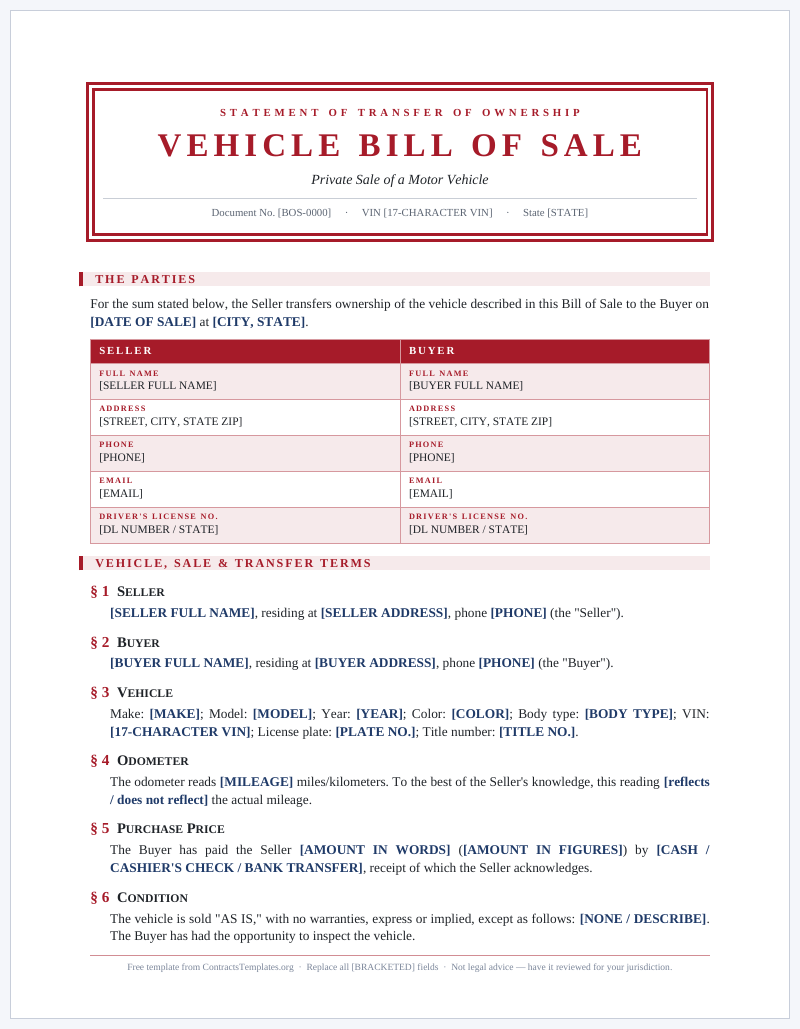
Template 1: Simple Vehicle Bill of Sale (One Page)
A clean one-page bill of sale with numbered sections for parties, vehicle description, price, as-is condition and seller’s ownership statement. Ideal for straightforward private cash sales.
- Fits on a single page
- VIN, odometer and price fields
- Standard “as is” and lien-free wording
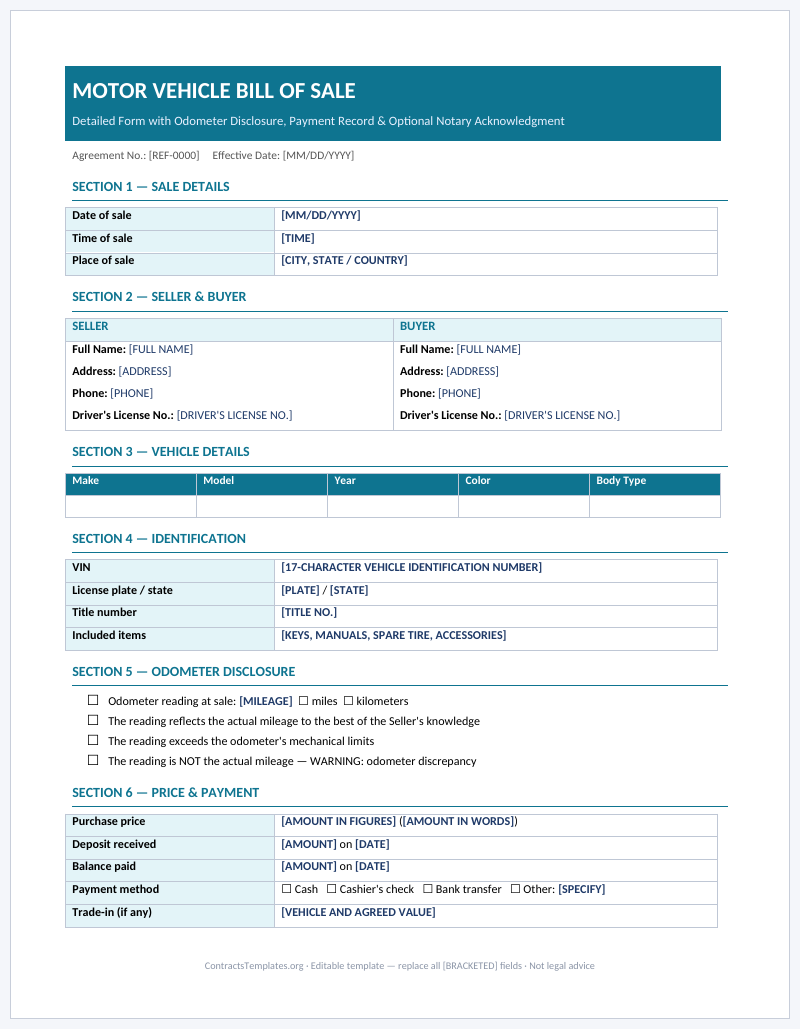
Template 2: Detailed Vehicle Bill of Sale with Odometer & Notary Block
A form-style bill of sale with seller and buyer tables, a full vehicle details grid, odometer disclosure checkboxes, payment method checkboxes, a condition section and an optional notary acknowledgment.
- Vehicle details table (VIN, plate, title no.)
- Odometer and payment checkboxes
- Optional notary acknowledgment section
When Do You Need a Vehicle Bill of Sale?
You should complete a bill of sale whenever a vehicle changes hands outside a dealership, including when:
- You sell or buy a used car privately, for example through an online listing.
- You give a vehicle to a family member as a gift (enter the price as a gift or nominal amount where allowed).
- You sell a motorcycle, ATV, boat trailer, camper or other titled vehicle.
- Your local motor vehicle office requires a bill of sale to register the vehicle or calculate sales tax.
- The vehicle is old or has no title, and the bill of sale is the main evidence of the transaction (rules for untitled vehicles vary by state).
- You want proof of the date and time of sale in case of later parking tickets, tolls or accidents.
What to Include in a Vehicle Bill of Sale
Seller and Buyer Details
Enter the full legal names, addresses and phone numbers of both parties. Some agencies also ask for a driver’s license number.
Vehicle Description
Include the make, model, year, body type, color and, most importantly, the Vehicle Identification Number (VIN). Copy the VIN directly from the vehicle and the title, and double-check every character. Add the license plate number and title number if available.
Odometer Reading
Record the mileage at the time of sale. In the United States, federal law requires an odometer disclosure for most vehicle transfers, typically on the title or a separate disclosure form, so check what your state requires. Note if the reading is known not to be the actual mileage.
Sale Price and Payment Method
State the price, the currency and how it was paid (cash, cashier’s check, bank transfer). If payment is made in installments, list the schedule or use a separate sale contract.
“As Is” Statement and Warranties
Most private sales are made “as is,” meaning the buyer accepts the vehicle in its current condition with no warranty. If the seller makes any promises, such as a recent repair or no known accident history, write them down.
Liens and Ownership Statement
The seller should confirm they are the legal owner and that the vehicle is free of liens, loans or claims, or disclose any lien that will be paid off at the sale.
Signatures, Date and Notarization
Both parties sign and date the bill of sale. Some states require notarization; the detailed template includes an optional notary block for that purpose.
How to Fill In the Bill of Sale Template
- Pick a version. Use the one-page bill of sale for a simple cash sale, or the detailed form when you want an odometer section, payment checkboxes and a notary block.
- Enter the date and location of sale. Include the city and state.
- Add both parties’ details. Use full legal names as they appear on identification.
- Describe the vehicle. Enter make, model, year, color, VIN, plate and title number.
- Record the odometer reading. Write the exact mileage shown.
- Enter the price and payment method. Write the amount in both words and figures to avoid ambiguity.
- Confirm the condition. Keep the “as is” wording or add any specific warranties agreed.
- Sign, notarize if required, and copy. Each party keeps a signed copy, and the buyer takes one to the motor vehicle office.
After the Sale: Next Steps for Buyers and Sellers
The bill of sale is only one part of a private vehicle sale. Once it is signed, both parties usually have a few more tasks:
- Seller: sign over the title, remove the license plates if your state requires it, cancel or transfer your insurance, and file any notice of transfer or release of liability your motor vehicle agency offers. Keep your copy of the bill of sale in case of later tickets or tolls.
- Buyer: arrange insurance before driving away, then take the title, bill of sale and identification to the motor vehicle office to register the vehicle and pay any sales tax or fees within the required time limit.
Tips and Common Mistakes
- VIN errors. One wrong character can cause registration problems. Compare the VIN on the dashboard, door frame and title.
- Leaving fields blank. Blank spaces can be altered later. Write “N/A” where something does not apply.
- Undervaluing the price. Writing a lower price to reduce tax may be illegal and can cause problems if the sale is reviewed.
- Handing over the car before payment clears. Wait for funds to clear, or use a cashier’s check you can verify with the issuing bank.
- Forgetting to notify the agency. Many states let sellers file a notice of transfer to end their liability for the vehicle.
- Not keeping a copy. Both parties should keep the bill of sale for several years.
For other property sales, see our sales contract template and purchase contract template, or browse the Sales Contracts category.
Frequently Asked Questions
Is a bill of sale the same as a title?
No. The title is the official certificate of ownership issued by the government. The bill of sale is a record of the sale that supports the title transfer. Most states require the title to be signed over; some also require a bill of sale.
Does a vehicle bill of sale need to be notarized?
It depends on your state or country. Many do not require notarization, but some do. Check your local motor vehicle agency’s rules. Our detailed template includes an optional notary acknowledgment section.
Can I write a bill of sale by hand?
Generally yes, as long as it includes all the required information and is signed by both parties. Using a template helps ensure nothing important, such as the VIN or odometer reading, is missed.
What does “sold as is” mean?
It means the buyer accepts the vehicle in its current condition and the seller makes no promises about its quality or future performance. The buyer should inspect the vehicle or have it inspected before signing.
Can I use this template for a motorcycle, trailer or boat?
The templates are designed for motor vehicles and work well for motorcycles, trailers and similar vehicles. For boats, you may need to add hull identification and engine details, and check your state’s specific boat registration requirements.
Legal Disclaimer
This vehicle bill of sale template is provided for general information only and is not legal advice. Vehicle registration, odometer disclosure and tax rules differ by state and country. Contact your local motor vehicle agency or an attorney for requirements that apply to you.