A catering contract template helps caterers and their clients agree on every detail of an event before the first dish is prepared. Weddings, corporate lunches, birthday parties and conferences all involve dates, guest numbers, menus, staffing, deposits and cancellation rules, and a written contract keeps everyone on the same page.
Below you can download two free, editable catering contracts in Word and PDF. Template 1 is a simple one-page catering agreement for smaller events. Template 2 is a detailed event catering form with an event details grid, menu table, staffing and equipment checkboxes, a pricing table and a payment schedule. Both are ready to customize for your business.
What Is a Catering Contract?
A catering contract is a service agreement between a caterer and a client that sets out the food and beverage services to be provided at an event. It confirms the date, venue, guest count, menu, service style, staffing, price, payment schedule and what happens if the event changes or is cancelled.
It is a specialized form of service contract. Like any service agreement, it defines the scope of work and the price, but it also covers issues specific to food service, such as dietary requirements, food safety, leftovers, alcohol service and final guest-count deadlines.
Download Free Catering Contract Templates (Word & PDF)
Choose a simple agreement for small events or the detailed event order form for weddings and corporate functions. Both are editable in Word and Google Docs.
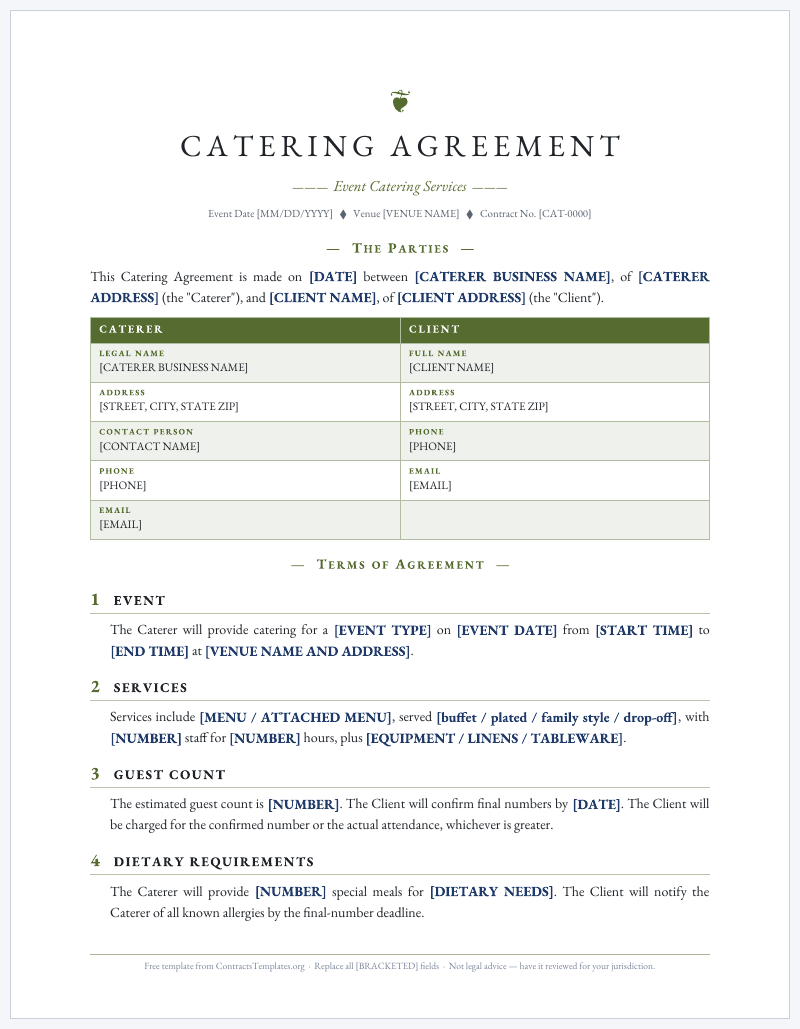
Template 1: Simple Catering Agreement (One Page)
A concise catering agreement with numbered clauses for event details, guest count, menu, price, deposit, cancellation and liability. Ideal for small parties, office lunches and drop-off catering.
- One-page clause-based layout
- Guest-count deadline and deposit terms
- Cancellation and liability wording
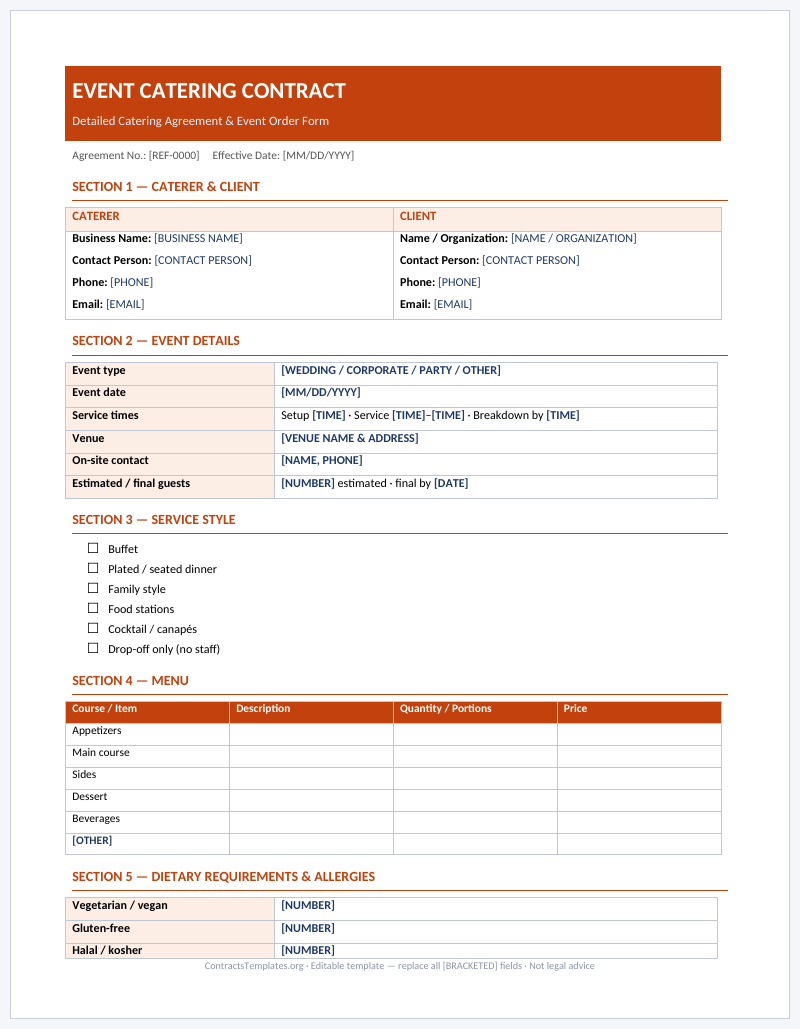
Template 2: Detailed Event Catering Contract & Order Form
A full event catering form with an event details grid, menu table, dietary requirements, staffing and equipment checkboxes, pricing breakdown and payment schedule table.
- Menu, quantities and dietary needs tables
- Staffing and equipment tick-boxes
- Pricing breakdown and payment schedule
When Do You Need a Catering Contract?
Caterers should use a written contract for every booking, no matter the size. Clients should also ask for one before paying a deposit. Typical events include:
- Weddings, engagement parties and anniversaries.
- Corporate events, conferences, training days and office lunches.
- Birthday parties, graduations and family celebrations.
- Fundraisers, galas and community events.
- Funerals and memorial receptions.
- Recurring arrangements, such as weekly staff meals or meal delivery for a business.
Events often involve several vendors. If you are also hiring a photographer, a photography contract can sit alongside your catering agreement, and post-event cleanup can be handled with a cleaning contract.
Key Clauses in a Catering Contract
Event Details
Record the event type, date, start and end times, venue address, on-site contact and access times for setup and breakdown.
Guest Count and Final Numbers
State the estimated guest count and a deadline for confirming final numbers, often one to two weeks before the event. Explain that the client is charged for the confirmed number even if fewer guests attend, and how increases after the deadline are handled.
Menu and Service Style
List the agreed menu or attach it, and specify the service style: buffet, plated, family style, food stations, canapés or drop-off. Note substitutions the caterer may make if ingredients are unavailable.
Dietary Requirements and Allergies
Record vegetarian, vegan, halal, kosher, gluten-free and allergy requirements, and explain how special meals will be labeled. Include a statement that the caterer takes reasonable care but that kitchens may handle common allergens.
Staffing, Equipment and Rentals
Specify how many servers, chefs and bartenders will attend and for how long, and what equipment is provided, such as chafing dishes, linens, tableware, glassware and tables.
Beverages and Alcohol
If alcohol is served, state who supplies it, who serves it, whether licensed bartenders are required and any venue rules on alcohol service.
Pricing, Deposit and Payment Schedule
Break down the price per person, staffing charges, rentals, service charges, gratuities and taxes. Set out the deposit amount and the due dates for remaining payments.
Cancellation and Changes
Explain refunds or charges if the client cancels at different stages, what happens if the caterer must cancel, and how events affected by circumstances beyond either party’s control will be handled.
Liability, Food Safety and Leftovers
State that the caterer will follow food safety rules and hold any required licenses and insurance. Clarify whether leftovers can be packaged for the client, since some caterers restrict this for safety reasons.
How to Fill In the Catering Contract Template
- Enter the caterer’s and client’s details. Include business name, contact person, phone and email.
- Complete the event details. Add event type, date, times, venue and on-site contact.
- Add guest numbers. Enter the estimated count and the final-number deadline.
- Fill in the menu table. List each course or item, service style and quantities.
- Record dietary needs. Note the number of special meals and any allergies.
- Tick staffing and equipment. Select what the caterer will supply.
- Complete the pricing table. Enter per-person prices, extra charges, taxes and the total.
- Set the payment schedule. Enter deposit and balance amounts and due dates.
- Review cancellation terms and sign. Both parties sign, and the client receives a copy with the deposit receipt.
Questions to Ask Before Signing a Catering Contract
If you are the client, the contract is your chance to clear up anything that could cause surprises on the day. Before signing, ask the caterer:
- Is a tasting included, and is it charged separately?
- What exactly is included in the per-person price, and what counts as an extra?
- How many staff will attend, and for how many hours? What is the overtime rate if the event runs late?
- Who sets up and clears tables, and who removes rubbish at the end of the night?
- Does the caterer hold the food safety licenses and insurance the venue requires?
- What happens if the guest count increases or decreases after the deadline?
If you are the caterer, answering these questions in the contract itself reduces back-and-forth emails and shows clients you are organized and professional.
Tips and Common Mistakes
- No final-number deadline. Without one, caterers risk over-ordering or being short on food.
- Unclear service charges. Explain the difference between a service charge and a gratuity, and whether either goes to staff.
- Forgetting venue rules. Check the venue’s kitchen access, power supply, alcohol policy and cleanup requirements.
- Missing overtime rates. Events often run late; set an hourly rate for staff beyond the agreed end time.
- Vague menu descriptions. Specify portion sizes or quantities where appropriate.
- No allergy process. Collect allergy information in writing and confirm how meals will be identified.
Explore more agreements for event and hospitality businesses in the Service Contracts category.
Frequently Asked Questions
How much deposit should a caterer take?
Deposits vary between businesses and markets. Many caterers ask for a deposit to secure the date and the balance before or shortly after the event. Whatever you choose, state the amount, whether it is refundable and the payment due dates in the contract.
When should final guest numbers be confirmed?
Commonly between one and two weeks before the event, which gives the caterer time to order ingredients and schedule staff. Put the exact deadline in the contract.
Is a catering contract legally binding?
Yes, once both parties sign a contract that clearly sets out the services, price and terms, it is generally a binding agreement. Enforceability depends on local law.
What happens if the client cancels the event?
The cancellation clause decides this. Many contracts allow a partial refund if the client cancels well in advance and keep the deposit or charge a higher percentage for late cancellations to cover costs already incurred.
Can I use this template for drop-off catering?
Yes. Select drop-off as the service style, remove staffing items that do not apply and add delivery time, packaging and any equipment that must be returned.
Should gratuity be included in a catering contract?
It is best to address it directly. Some caterers add a fixed service charge that covers administration and staffing costs, while others leave tipping to the client’s discretion. Clients often assume a “service charge” is a tip for staff, so the contract should state what each charge covers, whether any portion goes to the serving team, and whether additional gratuity is expected or optional. Clear wording avoids awkward conversations at the end of the event and helps clients budget accurately.
Legal Disclaimer
This catering contract template is for general information only and is not legal advice. Food safety, alcohol licensing, consumer protection and tax rules vary by location. Consult a qualified professional before relying on the template for your business.