An independent contractor agreement template helps businesses and freelancers put the terms of a project in writing before any work begins. It records what will be delivered, how much it will cost, when payment is due and, just as importantly, confirms that the worker is self-employed rather than an employee.
On this page you can download two free, editable versions: a one-page short-form agreement for small or one-off jobs, and a detailed form-style agreement with a milestone table, payment schedule and intellectual property terms for larger projects. We also walk through the clauses that matter and the mistakes that cause disputes.
What Is an Independent Contractor Agreement?
An independent contractor agreement is a written contract between a client (the business hiring) and a contractor (an individual or company providing services on a self-employed basis). It defines the services, deliverables, fees, deadlines and ownership of work product, and it states that the contractor controls how the work is done.
The agreement is similar to a consulting contract template, but it is broader: it can cover writers, developers, designers, tradespeople, bookkeepers, virtual assistants and almost any freelance role. If a contractor brings in their own helpers to deliver part of the job, a separate subcontractor agreement can be used between the contractor and those helpers.
Download Free Independent Contractor Agreement Templates
Both versions are free to download and edit in Word or Google Docs. Replace the [BRACKETED] text with your details, delete what you do not need, and save as PDF for signing.
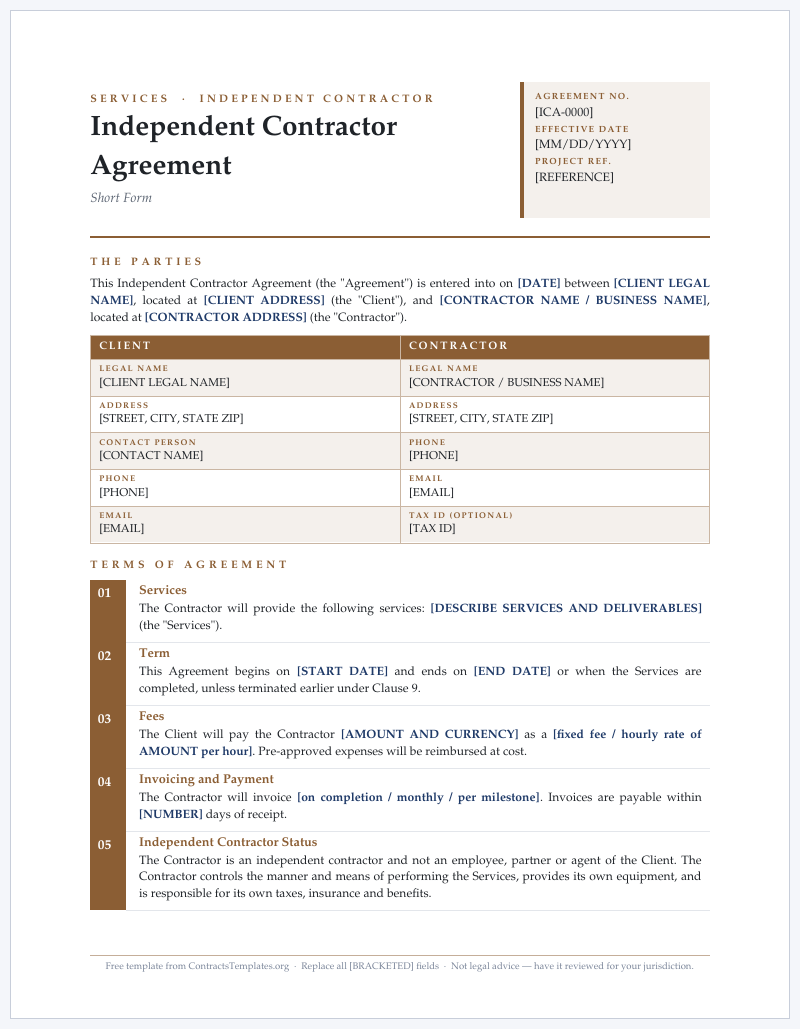
Template 1: Short-Form Independent Contractor Agreement
A concise one-page agreement with numbered clauses covering services, payment, contractor status, IP and termination. Best for small, clearly defined freelance jobs.
- One page, easy to read and sign
- Fixed-fee or hourly payment wording
- IP transfers to client on full payment
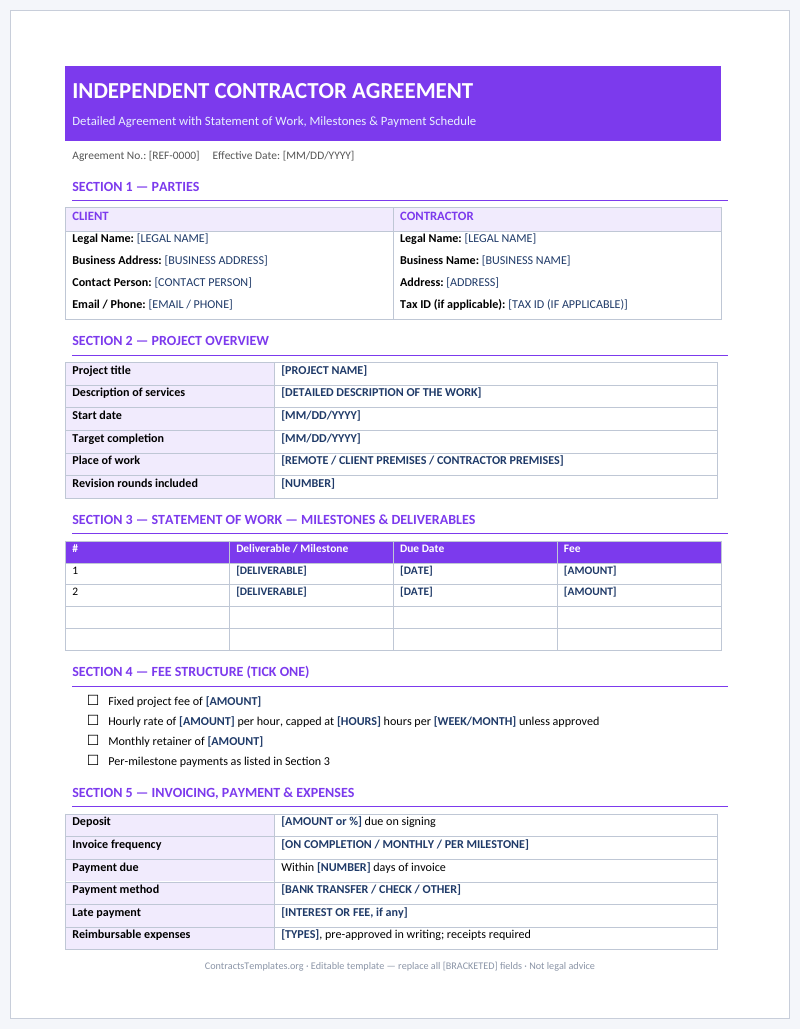
Template 2: Detailed Contractor Agreement with Milestones
A multi-page, form-style agreement with party tables, a milestone and deliverables table, payment checkboxes, an expenses section and a signature table. Built for larger or ongoing projects.
- Milestone, deliverable and due-date table
- Fee structure checkboxes and invoicing details
- Insurance, confidentiality and termination sections
When Do You Need an Independent Contractor Agreement?
Any time you pay someone outside your payroll to perform work, a written agreement protects both sides. Common scenarios include:
- Hiring a freelancer for a defined project such as a website, logo, article series or software feature.
- Engaging a specialist for ongoing monthly work, such as bookkeeping or IT support, without hiring them as staff.
- Working as a freelancer yourself and wanting clear payment terms before starting.
- Outsourcing tasks to a remote worker in another state or country.
- Bringing in seasonal or temporary help for a specific busy period.
Without a contract, disagreements over scope, late payment and who owns the finished work are far more likely, and the relationship may be harder to defend if a tax authority later questions the worker’s status.
Key Clauses in an Independent Contractor Agreement
Scope of Services and Deliverables
Describe the work in plain, specific language: what will be delivered, in what format and to what standard. If the project is large, attach a statement of work or milestone table, as in our detailed template.
Independent Contractor Status
This clause states that the contractor is not an employee, partner or agent, controls the manner and means of the work, supplies their own tools and is responsible for their own taxes, insurance and benefits. Remember that labels alone do not decide worker status; authorities look at how the relationship actually works in practice.
Fees and Payment Terms
Set out whether the contractor is paid a fixed fee, an hourly rate or per milestone, how invoices are submitted and how quickly they must be paid. Include whether expenses are reimbursed and whether a deposit is required.
Timeline and Term
Give a start date, key deadlines and an end date, or state that the agreement continues until either party ends it with notice.
Intellectual Property
Decide who owns the work product. Many clients require that all deliverables become their property once paid for in full, while the contractor keeps ownership of pre-existing tools and know-how. Be explicit, because default ownership rules vary.
Confidentiality
Require the contractor to keep client information private. For sensitive projects, sign a separate non-disclosure agreement as well.
Termination
Explain how either party may end the agreement, how much notice is needed and how work completed up to that date will be paid.
Liability, Insurance and Governing Law
Limit liability to a sensible amount, state any insurance the contractor must carry and name the governing law and dispute resolution method.
Independent Contractor vs. Employee: Why the Difference Matters
Getting classification right is one of the main reasons to use a written contractor agreement. Employees are usually entitled to payroll tax withholding, minimum wage and overtime protections, paid leave and other benefits, depending on where you are. Independent contractors are generally responsible for their own taxes and benefits, set their own schedules and can work for multiple clients at once.
Authorities in many countries use a combination of factors to decide which category applies. Common questions include:
- Control: Does the client direct how, when and where the work is done, or only the end result?
- Financial independence: Does the worker invest in their own equipment, set their own prices and carry the risk of profit or loss?
- Integration: Is the worker performing the core, ongoing work of the business alongside employees, or a defined project?
- Exclusivity: Is the worker free to offer services to other clients?
- Permanence: Is the relationship open-ended, or tied to a specific project or period?
If most answers point toward control by the client and an open-ended, exclusive relationship, the worker may be treated as an employee regardless of the contract wording. In that case, an employment contract is usually the safer choice. Keeping the contract consistent with how you actually work together is the best protection for both sides.
How to Fill In the Template
- Identify both parties. Enter the client’s and contractor’s full legal names, business names (if any) and addresses.
- Describe the services. Write a clear description of the work. In the detailed template, list each deliverable and its due date in the milestone table.
- Choose the fee structure. Tick fixed fee, hourly or milestone-based and enter the amounts and currency.
- Set payment terms. Enter the invoice frequency and payment window, such as 14 or 30 days.
- Confirm IP ownership. Choose whether ownership transfers to the client on payment or whether the client receives a license.
- Add the term and notice period. Enter start and end dates and the number of days’ notice for termination.
- Sign and store. Both parties sign, and each keeps a copy.
Tips and Common Mistakes
- Treating a contractor like an employee. Setting fixed working hours, providing equipment and closely supervising methods can undermine contractor status, regardless of what the contract says.
- Vague scope. “Build a website” invites disagreement. List pages, features, revision rounds and file formats.
- No change-order process. Agree in writing how extra work will be priced before it starts.
- Missing IP transfer. If ownership is not addressed, the client may not own the work it paid for.
- Forgetting tax paperwork. Collect any tax forms your country requires for payments to self-employed workers.
- No termination clause. Without one, ending a poor relationship can become expensive.
For other freelance arrangements, see our service contract template and the full Freelance Contracts category.
Frequently Asked Questions
What should an independent contractor agreement include?
At minimum: the parties, a description of services, fees and payment terms, the timeline, a statement of independent contractor status, intellectual property ownership, confidentiality, termination rights and signatures.
Does signing a contractor agreement guarantee contractor status?
No. The agreement is important evidence, but tax and labor authorities look at the real working relationship, such as who controls the work, who provides tools and whether the worker serves other clients.
Who owns the work created by an independent contractor?
It depends on the contract and local law. Without a written assignment, the contractor may retain ownership of what they create. Use the intellectual property clause to transfer ownership or grant a license.
Can I use this template for an ongoing monthly arrangement?
Yes. Set the fee as a monthly retainer or hourly rate, describe the recurring services and make the term continue until either party gives written notice.
Do independent contractor agreements need to be notarized?
Usually not. A signed written agreement is generally sufficient. Electronic signatures are widely accepted for this type of contract.
Legal Disclaimer
This independent contractor agreement template and article are for general information only and are not legal advice. Worker classification and contract rules vary by jurisdiction. Speak with a qualified lawyer or tax professional before using any template for your business.