

A Partnership Contract Template helps business partners put their shared business arrangements in writing. A strong partnership agreement can clarify ownership, contributions, management authority, profit and loss sharing, decision-making, and what happens if a partner leaves.
What Is a Partnership Contract?
A partnership contract, often called a partnership agreement or partnership deed, establishes the terms under which two or more partners operate a business together. The legal rules governing partnerships vary by jurisdiction, so the agreement should be adapted to applicable law.
Key Clauses to Include
- Business details: Partnership name, purpose, address, and nature of business.
- Partners: Names, addresses, ownership percentages, and roles.
- Capital: Initial contributions and rules for additional funding.
- Profits and losses: Agreed allocation and distribution procedure.
- Management: Duties, authority, voting, and major business decisions.
- Compensation: Partner salaries, drawings, reimbursements, or interest where applicable.
- Records: Accounting, bank access, reporting, and inspection rights.
- Exit and dissolution: Withdrawal, death, transfer, buyout, and winding-up provisions.
- Disputes: A process for resolving disagreements between partners.
Benefits of a Written Partnership Agreement
Putting the arrangement in writing creates clearer expectations and can reduce disputes over money, authority, responsibilities, and ownership. It also gives partners a structured document to review as the business develops.
Before Signing
Discuss contributions, ownership, decision-making, partner compensation, borrowing authority, admission of new partners, exit rights, and dissolution before signing. Professional legal and accounting advice may be appropriate for a significant business.
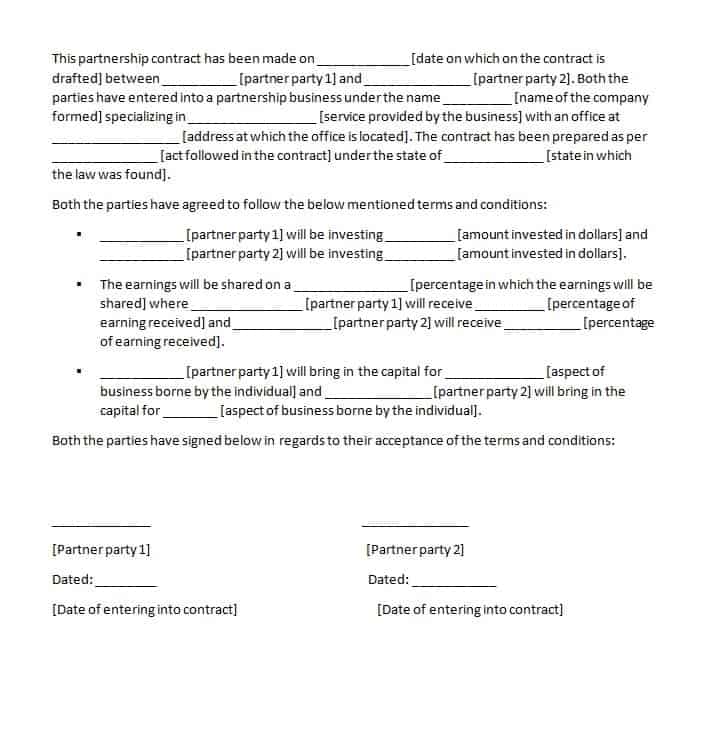
Free Partnership Contract Template
Use the sample below as a starting point and customize it for the partnership.

How to Use the Template
- Download and open the document.
- Enter partner and business details.
- Set capital, ownership, profit-sharing, and management terms.
- Add exit, dispute, and dissolution provisions.
- Have all partners review and sign the final agreement.
Decisions Partners Should Make Before Signing
Partners should agree on ownership percentages, initial and future contributions, profit and loss allocation, management authority, voting thresholds, banking controls, accounting records, salaries or draws, and restrictions on competing activities. The agreement should explain which decisions one partner may make alone and which require unanimous approval.
Planning for Changes and Exit
A partnership agreement should anticipate admission of new partners, voluntary withdrawal, incapacity, death, expulsion for serious misconduct, sale of an ownership interest, and dissolution. A valuation method or buyout formula can reduce uncertainty when a partner leaves. The document should also address confidentiality, intellectual property, customer relationships, dispute resolution, governing law, and the process for amending the contract.
Because partnership rules and tax consequences vary, all parties should review the completed document carefully and obtain professional advice where the business, investment, or potential liability is significant.
Before You Use a Partnership Contract
Discuss the difficult scenarios before writing the easy ones. In addition to contributions and profit sharing, decide who can bind the partnership, spending and borrowing limits, voting rules, partner compensation, access to records, admission of new partners, and what happens if partners disagree.
Example: Separate Ownership From Work Compensation
Two partners may each own 50% but contribute different amounts of day-to-day work. The agreement can separately address ownership, profit allocation, salaries or draws, and reimbursement of expenses instead of assuming one percentage answers every financial question. This distinction can prevent resentment and accounting confusion.
Common Mistakes to Avoid
Avoid waiting until a partner wants to leave before discussing valuation and buyout terms. Plan for death, incapacity, misconduct, deadlock, new investment, and dissolution. Also identify intellectual property or customer relationships brought into the partnership and what happens to them if the partnership ends.
Frequently Asked Questions
Can partnership agreements be customized?
Yes. They should reflect the actual ownership, contributions, roles, and business arrangements.
Why define profit sharing?
A clear formula reduces uncertainty about how profits and losses are allocated.
Should partner exit rights be included?
Yes. Planning for withdrawal, transfer, death, or dissolution can prevent difficult disputes later.
Is this legal advice?
No. This is a general template for document preparation and should be reviewed for the relevant jurisdiction.
Partnership Contract: Practical Review Checklist
Before using or signing this document, review every blank field and clause against the actual transaction. Confirm the legal names of the parties, dates, payment or consideration, responsibilities, deadlines, approval requirements, termination rights, and signature details. Remove provisions that do not apply and add any project-specific terms that are important to the arrangement.
Customize the Agreement for the Actual Situation
A downloadable contract sample is most useful as a drafting starting point. Avoid leaving generic wording unchanged when the real arrangement has different deliverables, payment milestones, notice periods, ownership rights, or risk allocation. Attach schedules, specifications, price lists, or other supporting documents when they form part of the agreement.
Final Checks Before Signing
- Check names, addresses, dates, amounts, and defined terms for consistency.
- Make sure responsibilities and deliverables are specific enough to understand and verify.
- Confirm payment dates, milestones, late-payment terms, and any deposits.
- Review renewal, cancellation, breach, notice, and termination provisions.
- Make sure all referenced exhibits and attachments are included.
- Keep a completed copy signed by all relevant parties.
Capital, Roles, and Decision-Making
A partnership agreement should record what each partner contributes at the beginning and how later contributions will be handled. Contributions may include cash, property, equipment, intellectual property, or services. Define ownership percentages separately from compensation if they are not the same. Specify day-to-day authority and identify major decisions that require a particular vote or unanimous approval.
Profits, Partner Changes, and Exit Planning
Explain how profits and losses are allocated, when distributions may be made, and whether partners receive salaries, draws, reimbursements, or other compensation. Plan for events that can disrupt the relationship: a partner wanting to leave, death or incapacity, admission of a new partner, serious breach, deadlock, or sale of the business. Buyout valuation, payment terms, access to records, restrictive covenants where lawful, and dissolution procedures deserve clear treatment before a dispute occurs.
Recordkeeping and Practical Use
Keep the signed agreement together with every attachment, amendment, approval, invoice, notice, and other document that affects the parties’ obligations. Important communications should be recorded in a durable form rather than relying on memory. Before signing, compare the final document with the negotiated deal, confirm that blank spaces are completed or intentionally removed, and make sure each party receives the same final version. Templates provide structure, but the finished agreement should reflect the actual transaction and applicable law.
Additional Practical Considerations
Partnership records deserve particular attention because partners may share ownership while performing different roles. The agreement can require accurate books, separate business accounts, agreed accounting periods, and reasonable access to financial records. It should explain who can sign contracts, borrow money, hire staff, make capital purchases, or commit the partnership above a stated amount. Consider how tax information will be prepared and distributed and who coordinates with accountants or other advisers. Periodic written approvals of major decisions and distributions can create a useful record and reduce later disagreement about what the partners authorized.
Legal Disclaimer
This Partnership Contract Template is provided for general informational and document-preparation purposes and is not legal advice. Partnership laws vary by jurisdiction. Obtain professional advice where appropriate.
