

An International Contract Template provides a structured starting point for agreements between parties located in different countries. Cross-border contracts require extra care because the transaction may involve different laws, currencies, taxes, customs requirements, business practices, and dispute-resolution systems.
What Is an International Contract?
An international contract is an agreement containing a cross-border element, such as a buyer and seller in different countries or services supplied internationally. The agreement should clearly identify the parties, transaction, applicable law, currency, delivery or performance obligations, and method for resolving disputes.
When Is an International Agreement Used?
International contracts are common for import and export sales, international consulting, distribution, licensing, technology services, manufacturing, supply arrangements, investments, and other cross-border business relationships.
Key Clauses to Include
- Parties and authority: Legal names, registered addresses, business details, and authorized signatories.
- Scope and deliverables: Exact goods, services, specifications, quantities, standards, and performance obligations.
- Price and currency: Agreed currency, exchange-rate provisions where necessary, taxes, and charges.
- Delivery and risk: Delivery location, shipping responsibilities, insurance, and appropriate trade terms.
- Payment: Payment method, due dates, banking charges, credit arrangements, and security mechanisms.
- Compliance: Applicable licensing, customs, product standards, sanctions, export controls, and regulatory requirements.
- Confidentiality and intellectual property: Protection of business information, technology, brands, and work product.
- Force majeure: Treatment of events outside reasonable control.
- Governing law and disputes: Applicable law, forum, arbitration or mediation, and jurisdiction.
Why International Contracts Need Extra Detail
A domestic agreement may operate within one familiar legal and commercial environment. A cross-border contract can involve multiple legal systems and practical issues such as currency conversion, international transportation, customs clearance, language, taxes, and enforcement. Clear drafting helps allocate these risks before the transaction begins.
International Sales and the CISG
The United Nations Convention on Contracts for the International Sale of Goods (CISG) may apply to qualifying international sales when its conditions are met, subject to the applicable legal framework and any valid contractual choices. It is important not to assume that every international contract is automatically governed by the CISG; professional advice should be obtained for significant transactions.
Things to Check Before Signing
Verify the identities and authority of both parties, confirm applicable laws and trade restrictions, choose the payment currency and method carefully, and define delivery, insurance, inspection, acceptance, warranties, liability, and dispute procedures. Consider professional advice in each relevant jurisdiction for complex transactions.
Free International Contract Template
The template below can help organize the basic structure of a cross-border agreement. Customize it for the actual parties, transaction, countries, currency, regulatory requirements, and negotiated terms.
Download International Contract template here for free
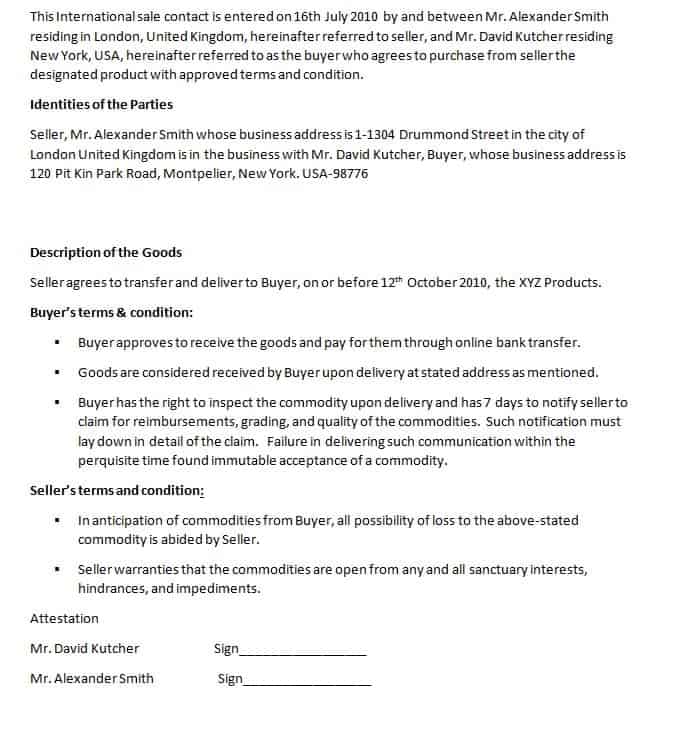

How to Use the Template
Complete the party information, describe the transaction, enter currency and payment terms, define delivery or performance obligations, and add governing-law and dispute provisions. Review all country-specific requirements before execution.
Before You Use an International Contract
Identify every cross-border element: the parties’ countries, place of performance, currencies, languages, payment route, data flows, intellectual property, transport, taxes, licenses, and regulatory requirements. Then decide which legal and operational issues require explicit treatment rather than assuming one country’s normal practice applies.
Example: Make Dispute Terms Complete
Writing only “disputes will be arbitrated” leaves important questions open. A more complete clause can identify the arbitration rules or institution, seat, language, number of arbitrators, and governing law, subject to professional review. If courts are selected instead, identify the intended jurisdiction and consider enforceability where the other party has assets.
Common Mistakes to Avoid
Do not use inconsistent language versions without stating which controls. Avoid leaving currency, bank fees, withholding tax, import duties, or exchange-rate mechanics ambiguous. Cross-border force majeure, sanctions, data-transfer, anti-bribery, and licensing issues should be considered when relevant rather than added as generic boilerplate.
Frequently Asked Questions
What makes a contract international?
A cross-border element, such as parties or performance in different countries, can make an agreement international.
Should an international contract specify currency?
Yes. The agreement should clearly state the currency and payment method.
Why is governing law important?
It helps determine which legal rules apply to interpreting and enforcing the agreement.
What is the CISG?
It is an international convention concerning qualifying contracts for the international sale of goods.
Can international contracts use arbitration?
Yes. Parties often select arbitration or another agreed dispute mechanism, subject to applicable law.
Is this template legal advice?
No. It is a general drafting resource and should be reviewed for the specific countries and transaction involved.
International Contract: Practical Review Checklist
Before using or signing this document, review every blank field and clause against the actual transaction. Confirm the legal names of the parties, dates, payment or consideration, responsibilities, deadlines, approval requirements, termination rights, and signature details. Remove provisions that do not apply and add any project-specific terms that are important to the arrangement.
Customize the Agreement for the Actual Situation
A downloadable contract sample is most useful as a drafting starting point. Avoid leaving generic wording unchanged when the real arrangement has different deliverables, payment milestones, notice periods, ownership rights, or risk allocation. Attach schedules, specifications, price lists, or other supporting documents when they form part of the agreement.
Final Checks Before Signing
- Check names, addresses, dates, amounts, and defined terms for consistency.
- Make sure responsibilities and deliverables are specific enough to understand and verify.
- Confirm payment dates, milestones, late-payment terms, and any deposits.
- Review renewal, cancellation, breach, notice, and termination provisions.
- Make sure all referenced exhibits and attachments are included.
- Keep a completed copy signed by all relevant parties.
Choice of Law and Cross-Border Enforcement
An international contract should not leave governing law and dispute procedure to chance. The parties can identify the law governing the agreement and select courts or arbitration where appropriate. If arbitration is chosen, important details can include the institution or rules, seat, language, number of arbitrators, and method of appointment. These provisions should be reviewed for enforceability in the countries involved.
Language, Currency, Tax, and Compliance
Cross-border agreements should state which language version controls if translations are used. Define the transaction currency, exchange-rate mechanism if relevant, banking fees, withholding taxes, duties, and invoicing requirements. Consider sanctions, anti-bribery obligations, import/export controls, data-transfer rules, intellectual-property protection, and local licensing requirements relevant to the transaction. A force-majeure clause should be drafted around realistic cross-border disruptions and should address notice, mitigation, suspension, and termination.
Recordkeeping and Practical Use
Keep the signed agreement together with every attachment, amendment, approval, invoice, notice, and other document that affects the parties’ obligations. Important communications should be recorded in a durable form rather than relying on memory. Before signing, compare the final document with the negotiated deal, confirm that blank spaces are completed or intentionally removed, and make sure each party receives the same final version. Templates provide structure, but the finished agreement should reflect the actual transaction and applicable law.
Legal Disclaimer
This International Contract Template is provided for general informational and drafting purposes and is not legal advice. Cross-border legal, tax, customs, sanctions, and regulatory requirements vary. Obtain qualified professional advice before using it for a specific international transaction.
